The Altar: Becoming Undone

Updated: Apr 2
An altar is a picture of sacrifice. Violence. Death.
An undoing.
As I reflect on the violent death that surrounds Jesus Christ's sacrifice on the cross, I also contemplate the structure that has been cemented in religious practice for generations.
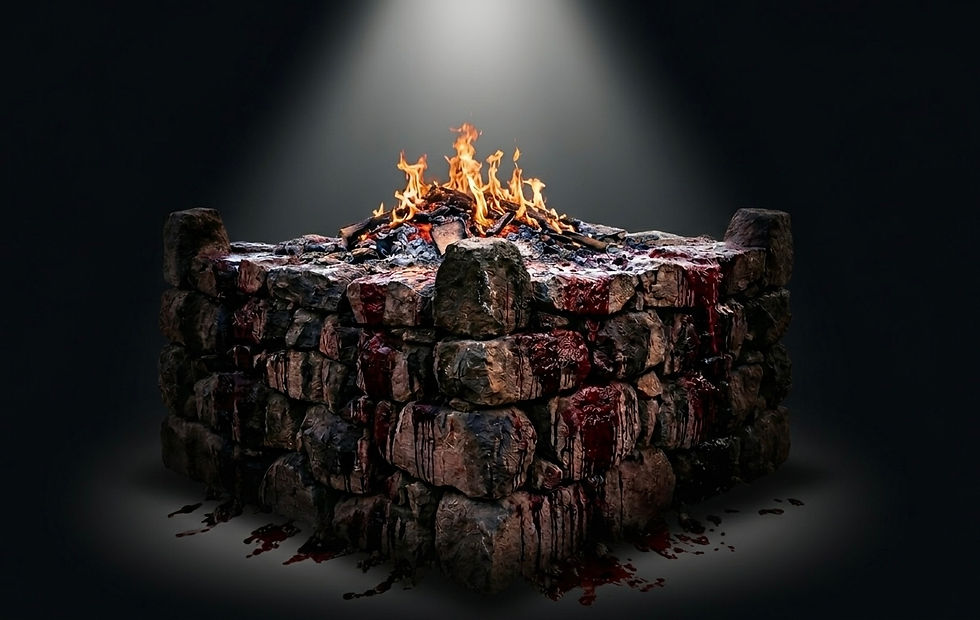
In scripture we are first introduced to the altar in Genesis 8:20 (NIV):
Then Noah built an altar to the Lord and, taking some of all the clean animals and clean birds, he sacrificed burnt offerings on it.
The scene contrasts in a jarring way with the verse that follows it in Genesis 8:21:
The Lord smelled the pleasing aroma and said in His heart: Never again will I curse the ground because of humans, even though every inclination of the human heart is evil from childhood. And never again will I destroy all living creatures, as I have done.
The smell of burning flesh of the carcass of an animal cut open is a pleasing aroma? How could this be? The image of violent and graphic slaughter compels us to turn our faces away. We are repulsed by the thought of it. Our present day context and lifestyle doesn't allow us to fully comprehend, let alone appreciate, the practice of animal sacrifice. There is no overstating the brutality of it all. However, it was common practice in Ancient Near Eastern (ANE) cultures. Sacrifices were often offered to deities for fertility, abundance in agriculture, or changes in the weather.
In order to understand the "pleasing aroma" of sacrifice, we may need to first understand its purpose and its practice.
Undoing the Destruction Caused by Moral Decay
Humanity's separation from God started with a choice: to go the way of our selfish ambitions instead of relying on and trusting God's providence and provision. So began our descent into depravity, reckless and unrestrained ambition, and moral decay. Sin.
Creation became tarnished by the evil inclinations of our hearts. To restore the balance of justice and the beauty of God's handiwork, a price has to be paid. Life has to be offered for life to be renewed. This is the symbolism of the redemptive sacrifice of the Passover lamb. The innocent life of a lamb is surrendered for the innocent life of all the firstborn of Egypt. The Bible Project beautifully illustrates this in their video about redemption.
This trade off reversed our separation from God.
An undoing.
It's not a coincidence that the first mention of an altar in scripture is by way of Noah after the flood. The sacrifice marked a renewal of life after complete destruction. A new beginning with a new creation in a new garden.
Reconciliation.
Undoing of the Self
The practice of sacrifice itself starts with the slaughter of an animal. The opening up of its body.
Its undoing.
It is a complete surrender of life over to lifelessness for a cause not its own. As it is consumed by fire the carcass is broken down into fundamental carbon components (ash) and smoke. The presence of fire in scripture holds strong symbolism:
as the presence of God
"When the sun had set and darkness had fallen, a smoking firepot with a blazing torch appeared and passed between the pieces." (Genesis 15:17, NIV)
"There the angel of the Lord appeared to him in flames of fire from within a bush. Moses saw that though the bush was on fire it did not burn up." (Exodus 3:2, NIV)
"By day the Lord went ahead of them in a pillar of cloud to guide them on their way and by night in a pillar of fire to give them light..." (Exodus 13:21, NIV)
as a means of purification to separate God's realm from the realm of humanity
"After He drove the man out, He place on the east side of the Garden of Eden cherubim and a flaming sword flashing back and forth to guard the way to the tree of life." (Genesis 3:24, NIV)
"Then one of the seraphim flew to me with a live coal in his hand, which he had taken with tongs from the altar. With it he touched by mouth and said, 'See, this has touched your lips; your guilt is taken away and your sin atoned for.'" (Isaiah 6:6-7, NIV)
After being engulfed by flames, the sacrifice then takes a different form. The smoke ascends and merges with the unseen realm.
Reconciliation.
(You may read more about the Hebrew sacrificial system in Leviticus chapters 1-7.)
Undoing the Power of Death
After being consumed by the flames on an altar, a once vibrant lamb takes a new form, free from the restrictions of a physical body. Its life, through its death, is given a new purpose and significance. It essentially becomes something else.
But first, it must die.
It's similar to what we observe in nature. A seed must perish before it transforms into a seedling. A caterpillar must cease to exist before it turns into a butterfly. To have new life, there must be death. For something to be renewed, something else must come to a conclusion.
In scripture, death is not simply ceasing to exist. Instead, death is what happens when we are separated from God's eternal life-giving presence.
But you must not eat from the tree of the knowledge of good and evil, for when you eat from it you will certainly die. (Genesis 2:17, NIV)
And the Lord God said, "The man has now become like one of us, knowing good and evil. He must not be allowed to reach out and take also from the tree of life and eat, and live forever." (Genesis 3: 22, NIV)
The deceiver understood the difference and exploited this widespread misunderstanding as a means of manipulation and exploitation, aiming to divert humanity from God's wisdom by seizing power for their own benefit.
You will not certainly die... For God knows that when you eat from it your eyes will be opened, and you will be like God, knowing good and evil." (Genesis 3:4-5, NIV)
Since then the threat of death has driven unabated exploitation, greed and selfishness.
But as the sacrifice on the altar shows us, death can be transformative. If we are to return to the Garden, we must pass the cherubim with its flaming sword. We must retrace the fateful pathway that separated us from the eternal presence of God.
An undoing.
Walking through the flames of death transforms us into new creation abiding in God's presence again.
Reconciliation.
If, therefore, death is a gateway to renewed life, where then is its power?
When the perishable has been clothed with the imperishable, and the mortality with immortality, then the saying that is written will come true: "Death has been swallowed up in victory." "Where, O death, is your victory? Where, O death, is your sting?" (1 Corinthians 15:55, NIV)
The Altar of The Cross
Perhaps now we can understand the miracle and beauty of the cross on which Jesus died.
Crucifixion was a form of capital punishment for high crimes during the period of the Roman occupation of Judea. Crimes such as robbery, treason, and murder were punishable by death. The timing of Christ's crucifixion was not by happenstance. During the festival of Passover - which celebrates freedom from death and enslavement by sacrificing an innocent lamb - the Son of God's life was exchanged for the notorious criminal Barabbas (whose name quite literally means "son of the father"). One innocent son's life was given for another. Barabbas (and by extension, humanity) was redeemed by the blood of an innocent man.
To restore the balance of justice and the beauty of creation, a price has to be paid. Life has to be offered for life to be renewed.
Jesus was mocked, beaten and made to carry the cross to Golgotha. His body, already broken down by being whipped, was nailed to the cross he carried, and hoisted for all to see. The cross became an altar where his body was undone.
And He took the bread, gave thanks and broke it, and gave it to them, saying, "This is my body given for you; do this in remembrance of me." (Luke 22:19, NIV)
But...
The beauty and profundity of the cross was in Christ's surrender. He disarmed the power of death by willingly surrendering Himself to it. His power over death was in His choice to do this; to demonstrate His love for humanity and pass through death's flames into eternal life to be reconciled with God.
This is what pleases God.
The reason my Father loves me is that I lay down my life - only to take it up again. No one takes it from me, but I lay it down of my own accord. I have the authority to lay it down and authority to take it up again. This command I received from my Father. (John 10:17-18, NIV)
Greater love has no one than this: to lay down one's life for one's friends. (John 15:13, NIV)
What does this mean for us? We are called to walk the pathway of undoing:
acknowledge and accept the atoning sacrifice made for us through the immeasurable grace and love of Jesus Christ,
surrender self, abandoning our own way for God's wise and loving plan reconciling us to Him, and
abide in the triumph of Christ's victory over death by adopting the values of the Kingdom of Heaven, even if it looks like surrender to those who are wise in their own eyes.
Therefore, I urge you, brothers and sisters, in view of God's mercy, to offer your bodies as a living sacrifice, holy and pleasing to God - this is your true and proper worship. (Romans 12:1, NIV)
A pleasing aroma indeed.

Comments